CFP: Word, Image, Digital

A one-day symposium, Cardiff University
Tuesday, 1 November 2016

Keynote Speaker: Michaela Mahlberg (University of Birmingham)

Download the PDF Here: cfp-wordimagedigital

Cardiff University’s Digital Cultures Network is delighted to announce its first Symposium on Word, Image and the Digital. Word and image, and the interplay between them, remain under explored and under-theorised in the digital humanities, despite the creation of pioneering digital archives including The William Blake Archive, the Rossetti Archive and The Illustration Archive. There is a sense, however, in which the digital is not only ‘graphical’ (as Johanna Drucker reminds us), but also a space where the visual and textual are in constant dialogue.

We invite proposals of up to 300 words for 20-minute papers that explore any aspect of the dynamic between word, image and the digital, including demonstrations of current projects. The deadline for submission of abstracts is Monday, 3 October 2016. Please send proposals or enquiries to Michael Goodman (GoodmanMJ@cardiff.ac.uk). Attendance at the Symposium is free and limited to no more than 30 delegates. While non-speaking delegates are welcome, priority will be given to speakers.

Formed in December 2015, and funded by Cardiff University’s College of Arts, Humanities and Social Science, the Cardiff Digital Cultures Network is an interdisciplinary grouping that aims to bring together researchers, creative practitioners and library/museum professionals involved with digital work to share expertise and best practice. As part of our programme of activities, over the course of the next nine months we will be hosting four Symposia on various aspects of digital culture, focusing on: Word, Image, Digital (November 2016); Curating the Digital Archive (January 2017); Remediation and Adaptation (March 2017); and Big Data (May 2017). More information about the Network and its events can be found on our website (cardiffdigitalnetwork.org) and by following us on Twitter (@CUdigitalnet).

Symposium organisers: Dawn Knight, Anthony Mandal, Julia Thomas


Ways of Seeing

Last week we launched the Victorian Illustrated Shakespeare Archive. Since then the archive has had a very positive response, with the popular educational website Open Culture writing a very engaging article that has currently received over 11,500 shares on social media and the Shakespeare Blog also writing another flattering piece. The past few days have been a real insight into the way social media works from the ‘other side’ – as a creator rather than passive participant – and I will be writing more about this in the future. For now, however, I would like to suggest that what accounts for this reaction is not just the content of the archive (although, certainly, Shakespeare illustration was always going to gain some attention), but rather it is the way the archive has been curated and designed to provide users with new ways of experiencing historical artefacts.

Continue reading

Shakespeare, Remediation and the Digital Archive

‘As an historian I find what you are doing horrifying’. This remark, directed at the paper I just gave at the Sheffield Digital Humanities Congress in 2012, is, on the face of it, not particularly encouraging. My paper, entitled ‘Art to Enchant: The Creation of a Digital Archive’ explored in detail my process and methodology in the creation of the Victorian Illustrated Shakespeare Archive (VISA). What particularly angered this member of the audience was my in-depth demonstration of the procedures I use to ‘clean up’ the images that make up the archive   and my subsequent assertion that when we digitise an historical artefact it becomes translated – adapted – into a different medium, thus creating an entirely new and original artefact. The audience member took great exception to this because it called into question his deeply held belief that we can know history as an objective fact; that the books, documents, and images we find in libraries and archives are transparent texts, that they reveal to us truths and give us direct access to their own historical eras.

Continue reading

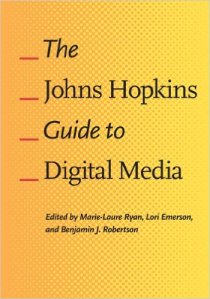
The Johns Hopkins Guide to Digital Media (2014)

Edited by Marie-Laure Ryan, Lori Emerson, and Benjamin J. Robertson. Baltimore: Johns Hopkins University Press. JHG

It is appropriate to begin our book review section with The Johns Hopkins Guide to Digital Media for a couple of reasons. First, in light of our recent blog post about digital pedagogy, the book provides an excellent starting point for students and teachers wishing to learn more about what is loosely called ‘New Media’. Second, the very form of the book, an encyclopaedic A-Z of key terms from the field (it begins with ‘Algorithm’ and ends with ‘Writing under Constraint’) is analogous to that of the web itself. Written in fragments and concluding with a further reading section, each entry reminds us that such reference guides are hypertextual by their very nature.

Continue reading

Things We Did in the Summer Part III

Higher Ground: Reflections on the AHRC Common Ground Event 
‘People, keep on learnin’, sang Stevie Wonder on his 1973 single ‘Higher Ground’ – a song that deals with themes of reincarnation and spirituality. As the opening line of the song, the words have a special relevance: they encapsulate the idea that it is through learning that we can reach the ‘higher ground’, the metaphoric space where we can become enlightened individuals, at one with both ourselves and the universe. ‘I’m so glad that I know more than I knew then / Gonna keep on tryin’ / Till I reach my highest ground’, the first chorus concludes before, pertinently enough, going into a verse that begins with the line ‘teachers, keep on teachin’.

Continue reading

Things We Did in the Summer Part II

Creative Cardiff Pop-Up Hub: Making a Difference

There is a scene early on in the Richard Attenborough-recreates-Alton-Towers-but-with-dinosaurs documentary, Jurassic Park, where, on learning that the eponymous park contains a T-Rex, the palaeontologist Alan Grant collapses to the ground overcome by excitement.  It is a scene re-enacted by myself in the Wales Millennium Centre when I learnt that Rhys Jones, a fellow participant in Creative Cardiff’s Pop-Up Hub had brought into our work environment an Oculus Rift. The Rift (as it is also known – the definitive article implying a kind of break with the past) has, as long-term readers of our Twitter feed, @cardiffdiginet, will be aware, been on our ‘thing’s to have a go on’ list for quite some time now. ‘You’ve got a Rift?’, I spluttered, my mouth full of Rainbow Drops (more of which shortly), ‘Yes’, Rhys said. ‘Come and give it a go’. Oh go on then.

Continue reading

Things We Did in the Summer Part I

Digital Pedagogies: The Shock of the (K)New

As summer is drawing to a (rainy) end and August is traditionally a quiet month within the University, it is a good moment to use this island of time in the ocean of conferences, meetings, symposiums and events that has characterised the Digital Cultures Network thus far, to update you with our recent activities over the summer. To paraphrase Mungo Jerry’s classic ‘In the Summertime’, have a drink, have a read…

Continue reading

Digital Storytelling

Exploring Patient and Family Experience of Hospitals and Medical Treatment – 18th May, JOMEC, Cardiff Univesity

Jenny Kidd (JOMEC)
Lisa Heledd (Storyworks)
Jenny Kitzinger (JOMEC)

Last week, the School of Journalism, Media and Cultural Studies (JOMEC) held a series of public events exploring digital storytelling and the significant impact this mode of expression can have on wider culture and the general public. ‘Exploring Patient and Family Experience of Hospitals and Medical Treatment’, was the most powerful and moving of these sessions and it was also the one that most explicitly demonstrated how digital storytelling can promote and actively encourage change within institutions through suggesting ways that allow professionals working in these institutions to listen to the voices of patients and their families.

Continue reading

JOMEC Event: Digital Storytelling

Research Seminar: Digital storytelling: exploring patient and family experience of hospitals and medical treatment – Dr JennyKidd, Lisa Heledd Jones & Professor Jenny Kitzinger 
When: 18 May 2016 16:00–18:00
Where: JOMEC BUTE building, King Edward VIIth Av, Room 0.05

Continue reading